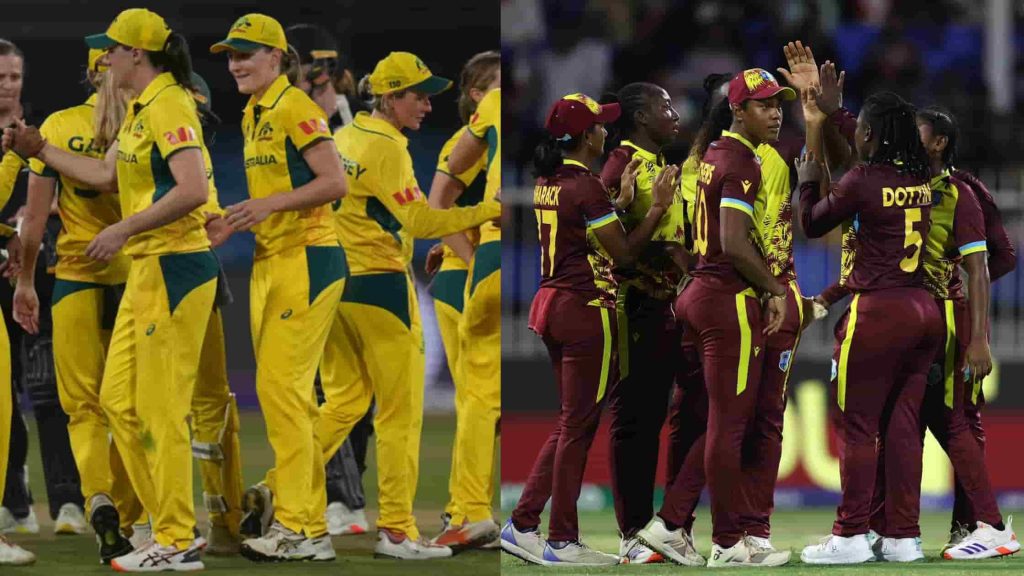
The ICC Women’s T20 World Cup 2026 is already rewriting scripts. England are dominant, defending champions New Zealand have lost both their opening matches, and dark horses like Sri Lanka and West Indies are gatecrashing the expected semifinal order.
With 12 teams across two groups and only the top two from each advancing to the knockout stage at The Oval, every point, and every run, matters from the very first ball. Here is the complete, updated points table with full context on how standings are calculated and which teams have the strongest case to go all the way.
ICC Women’s T20 World Cup 2026 Points Table — Updated Standings
Follow the latest Group A standings, points, and net run rate as teams compete for a place in the knockout stage.
Group A
| Pos | Team | P | W | L | NR | Pts | NRR |
|---|---|---|---|---|---|---|---|
| 1 | Australia Women | 3 | 3 | 0 | 0 | 6 | +4.391 |
| 2 | India Women | 3 | 2 | 1 | 0 | 4 | +2.511 |
| 3 | South Africa Women | 3 | 2 | 1 | 0 | 4 | -0.546 |
| 4 | Bangladesh Women | 3 | 2 | 1 | 0 | 4 | -0.641 |
| 5 | Pakistan Women (E) | 3 | 0 | 3 | 0 | 0 | -1.857 |
| 6 | Netherlands Women (E) | 3 | 0 | 3 | 0 | 0 | -3.384 |
Group B
| Pos | Team | P | W | L | NR | Pts | NRR |
|---|---|---|---|---|---|---|---|
| 1 | England Women | 3 | 3 | 0 | 0 | 6 | +2.490 |
| 2 | West Indies Women | 3 | 3 | 0 | 0 | 6 | +0.644 |
| 3 | New Zealand Women | 3 | 1 | 2 | 0 | 2 | -0.063 |
| 4 | Scotland Women | 3 | 1 | 2 | 0 | 2 | -0.083 |
| 5 | Sri Lanka Women | 3 | 1 | 2 | 0 | 2 | -1.913 |
| 6 | Ireland Women (E) | 3 | 0 | 3 | 0 | 0 | -1.054 |
ICC Women’s T20 World Cup 2026 Format & Qualification Rules
Teams compete in the group stage to earn points and qualify for the knockout rounds. The top teams then advance to the semifinals and final.

How Points Are Awarded in ICC Women’s T20 World Cup 2026
| Result | Points Awarded |
|---|---|
| Win | 2 points |
| Loss | 0 points |
| No Result / Abandoned | 1 point each team |
| Tie | 1 point each team |
When two or more teams finish level on points at the end of the group stage, the ICC applies tiebreakers in the following order:
- Net Run Rate (NRR) — the primary differentiator
- Head-to-head result between the tied teams
- Fewer wickets lost per runs scored (in tied head-to-head)
- ICC T20I Rankings prior to the tournament (final tiebreaker)
How Net Run Rate (NRR) Is Calculated in ICC Women’s T20 World Cup 2026
NRR is the number that separates teams on equal points, and yet it is the least understood metric in cricket. Here is precisely how it works.
NRR Formula:
NRR = (Total Runs Scored ÷ Total Overs Faced) − (Total Runs Conceded ÷ Total Overs Bowled)
A positive NRR means you are scoring faster than you are conceding. A negative NRR means the opposite.
Practical example using England’s opening match:
- England scored 219/1 in 20 overs and conceded 132 in 20 overs
- Run rate scored: 219 ÷ 20 = 10.95
- Run rate conceded: 132 ÷ 20 = 6.60
- NRR from this match: 10.95 − 6.60 = +4.35
This is why teams in dominant positions still push for more runs or bowl opponents out cheaply rather than coast to the finish line — every additional run and every wicket taken while managing overs directly impacts NRR, which can be the difference between qualification and elimination.
Key NRR rules to know:
- If a team is bowled out before 20 overs, the full 20 overs are counted in the denominator, not just the overs used, this is why being bowled out for a low score is so damaging to NRR
- Rain-affected matches use D/L par scores and revised overs for NRR calculation
- NRR accumulates across all group matches — it is a tournament-wide metric, not match-by-match
Top Contenders With the Strongest Winning Pedigree at ICC Women’s T20 World Cup
The tournament features several experienced teams with a proven record in ICC events. Their winning pedigree makes them strong title contenders.
Australia Women — The Most Decorated Side in the Tournament
Australia have won the ICC Women’s T20 World Cup five times, more than any other nation. They do not just reach knockout rounds, they dominate them.
Why they go deep every time:
- Deepest batting lineup in women’s cricket — rarely dependent on one player
- Pace and spin options that adapt to any surface or condition
- Beth Mooney, Ellyse Perry, and Tahlia McGrath bring ICC knockout experience few squads can match
- Unmatched record of absorbing early pressure and still winning matches
India Women — Consistent Contenders Searching for the Title
India have reached the final twice without winning it. That is the paradox of this squad. What has shifted is the maturity of their core, Smriti Mandhana, Deepti Sharma, and Harmanpreet Kaur are all now at the peak of their powers.
Why they are always a serious threat:
- Deepti Sharma is the highest wicket-taker in Women’s T20I history — 166 wickets and counting
- Spin-heavy attack that suits both subcontinental and English conditions
- Harmanpreet Kaur’s captaincy record in T20Is is among the best in women’s cricket
England Women — Home Advantage Backed by World-Class Bowling
England won the inaugural ICC Women’s T20 World Cup in 2009, on home soil. History may not repeat, but conditions heavily favour them. Sophie Ecclestone remains one of the best left-arm spinners in the world.
Why home conditions amplify their threat:
- English pitches and overcast skies suit their pace-led powerplay attack
- Ecclestone and Charlie Dean form a spin partnership that is near-unplayable under lights
- England consistently outperform their away record when playing at home in ICC events
What the NRR Numbers Are Telling Us Right Now
The points table after Match Week 1 reveals something important that the win/loss column alone does not:
- Australia and India are separated by just 0.05 NRR (+3.250 vs +3.200) — their June 28 head-to-head match could be a de facto group final
- Pakistan and South Africa’s NRR of −3.200 and −3.250 means that even winning their remaining four matches may not be sufficient if they cannot improve run rates dramatically
- Scotland’s +2.000 NRR is genuinely impressive for a team historically classified as an Associate Nation — they are playing like a top-six side
- New Zealand’s −0.200 NRR is misleading because both losses were close — but it means they cannot afford a heavy defeat in any remaining match
ICC Women’s T20 World Cup 2026 Semifinal Qualification Scenarios
Based on the current standings, here is how qualification is shaping up:
Group A — Near-certain qualifiers:
- Australia Women
- India Women
Group A — Still in contention:
- Bangladesh Women (need wins and NRR maintenance)
- South Africa Women and Pakistan Women (need immediate wins and big margins)
Group B — Near-certain qualifier:
- England Women
Group B — Wide open for second spot:
- Scotland Women, West Indies Women, and Sri Lanka Women are all on 2 points
- New Zealand Women are alive but need to win all remaining matches
- Ireland Women need a miracle
Final Verdict
The ICC Women’s T20 World Cup 2026 has opened with the kind of unpredictability that makes knockout-format tournaments compelling.
England and Australia look the class of their groups, but Scotland’s rise, Sri Lanka’s stunning win over New Zealand, and the defending champions’ collapse are proof that the points table is only ever a snapshot.
Every decimal point of NRR, every early wicket, every over bowled cheaply has direct implications on who walks out at The Oval for the semifinals.