Mio Otani (Japan) holds the record as the all-time top scorer in the AFC Women’s Asian Cup with 16+ goals, including a record-breaking 16 goals in the 2001 edition alone.
She is closely followed by Sam Kerr (Australia) with 12 goals as of 2022, and by Chinese stars Jin Yan and Bai Jie with 12+ and 11+ goals, respectively.
The AFC Women’s Asian Cup is the oldest women’s international football tournament in the world, running since 1975. Over 20 editions, it has produced some of Asia’s fiercest goal scorers.
This guide covers every major name on that list, their tournament contributions, and what the ongoing 2026 edition in Australia means for these records.
Top 10 All-Time Goalscorers in the AFC Women’s Asian Cup
Before we break down each player’s story, here is the complete top 10 at a glance.
Note: Several of these tallies come from older editions with limited statistical tracking. Numbers marked with “+” indicate approximate totals based on available historical data.
| Rank | Player | Country | Goals | Key Tournament(s) |
|---|---|---|---|---|
| 1 | Mio Otani | Japan | 16+ | 2001 (record 16 goals) |
| 2 | Sam Kerr | Australia | 12 | 2018, 2022 (5 vs Indonesia) |
| 3 | Jin Yan | China | 12+ | Multiple editions (1990s–2000s) |
| 4 | Bai Jie | China | 11+ | Multiple editions (1990s–2000s) |
| 5 | Li Ying | China | 10+ | 2018 (7 goals) |
| 6 | Homare Sawa | Japan | 10+ | 2003 (6 goals), 2014 champion |
| 7 | Ri Kum-suk | North Korea | 8+ | 2008 (7 goals) |
| 8 | Lisa De Vanna | Australia | 7 | Across 4 tournaments |
| 9 | Yūki Nagasato | Japan | 7 | 2006 edition |
| 10 | Jung Jung-suk | South Korea | 7 | 2006 edition |
Now, let’s look at the players who shaped these numbers.
1. Mio Otani (Japan) – The Record Holder Nobody Talks About Enough
Mio Otani sits at the top of this list with 16+ all-time goals in the AFC Women’s Asian Cup. And most of that damage came in a single tournament.
In the 2001 edition, Otani scored a record 16 goals in one tournament. That number still stands as the highest individual tally in a single Women’s Asian Cup.
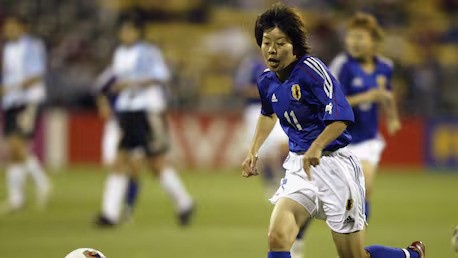
She followed that up in 2003, scoring 9 goals, including 7 against the Philippines in Japan’s 15–0 win.
Quick Profile: Mio Otani
- Born: May 5, 1979, Koka, Japan
- International Career: 2000–2007 (73 caps, 31 goals)
- Club: Tasaki Perule FC (1998–2008)
- L.League record: 150 goals in 180 matches
- Also represented Japan at the 2003 and 2007 FIFA Women’s World Cups and the 2004 Athens Olympics
Otani’s club, Tasaki Perule FC, was disbanded in 2008 due to financial problems, which ended her career prematurely. Despite that, her Asian Cup goal record has remained untouched for over two decades.
2. Sam Kerr (Australia) – The Modern-Day Asian Cup Machine
Sam Kerr needs no introduction for football fans. With 12 goals across the 2018 and 2022 editions, she’s Australia’s all-time top scorer in the tournament.
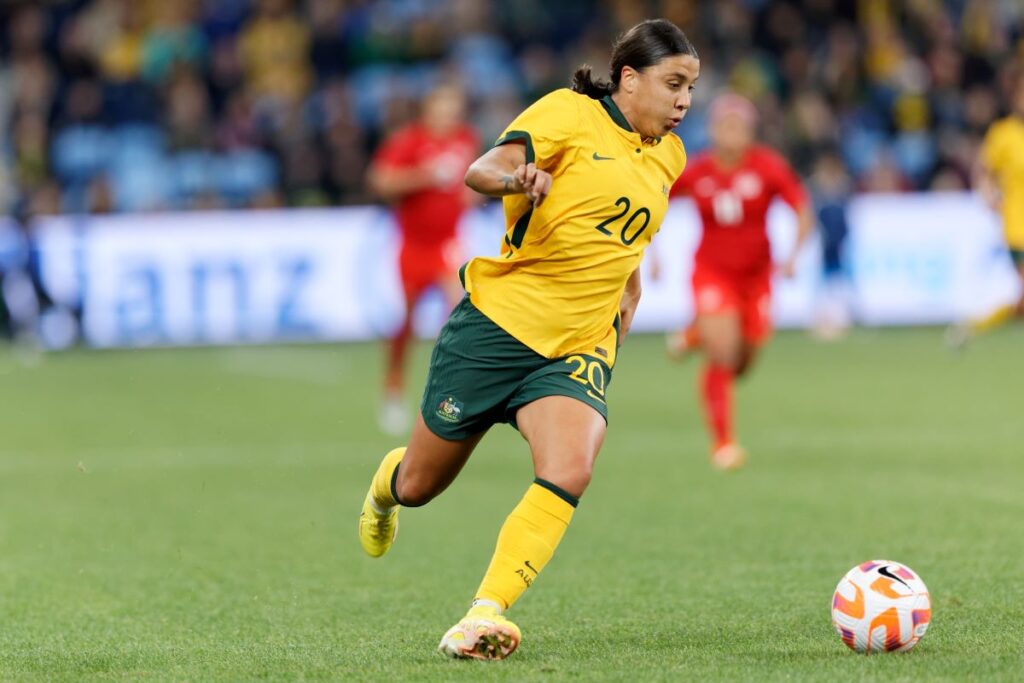
Her defining moment? A five-goal haul against Indonesia at the 2022 Women’s Asian Cup in India. That’s the kind of performance that lands you in the record books permanently.
In the 2026 edition, hosted on home soil in Australia, Kerr has been leading the Matildas’ attack once again. With the semifinals still to play, her all-time tally could grow even further.
What Makes Kerr Special at the Asian Cup
It’s not just about volume. Kerr tends to score in clusters when it matters. She also won the 2022 Golden Boot with 7 goals in that single edition.
Interestingly, Alanna Kennedy has emerged as one of the top scorers in 2026 with 5 goals through the quarterfinals, showing that Australia’s goal threat extends well beyond Kerr.
3. Jin Yan (China) – The Silent Force in China’s Golden Era
Jin Yan accumulated 12+ goals during China’s period of dominance in the 1990s and 2000s.
China won seven consecutive AFC Women’s Asian Cup titles between 1986 and 1999, and Jin Yan was a key part of that scoring machine.
Detailed match-by-match breakdowns from those earlier editions are limited. But what we do know is that Jin Yan’s consistency across multiple tournaments cemented her as one of China’s greatest forwards of that era.
4. Bai Jie (China) – Another Gem from China’s Winning Dynasty
With 11+ goals, Bai Jie is another product of the incredible Chinese women’s football factory that dominated the 1990s.
She played alongside legends like Sun Wen, who was named FIFA Female Player of the Century in 2000, alongside Michelle Akers.
Together, they powered China’s run of four straight Asian Cup titles (1991, 1993, 1995, 1997) and a runners-up finish at the 1999 FIFA Women’s World Cup.
5. Li Ying (China) – The 2018 Breakout Star
Li Ying has 10+ goals in the tournament, with 7 of those coming in a single edition: the 2018 AFC Women’s Asian Cup in Jordan.
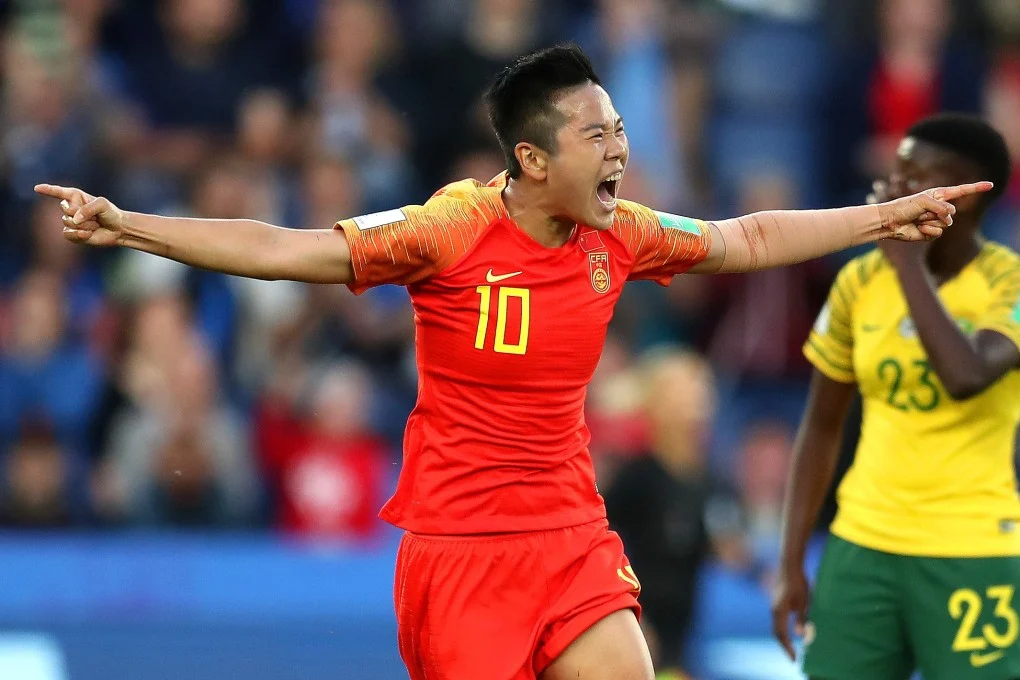
That 2018 performance put her on the global radar. She went on to represent China at the 2019 FIFA Women’s World Cup in France, where she scored against South Africa in the group stage.
What’s worth noting is that Li Ying is a more modern-era scorer compared to many on this list. Her goals came in a period when the tournament had more teams and tighter competition.
6. Homare Sawa (Japan) – The Greatest Asian Footballer of All Time
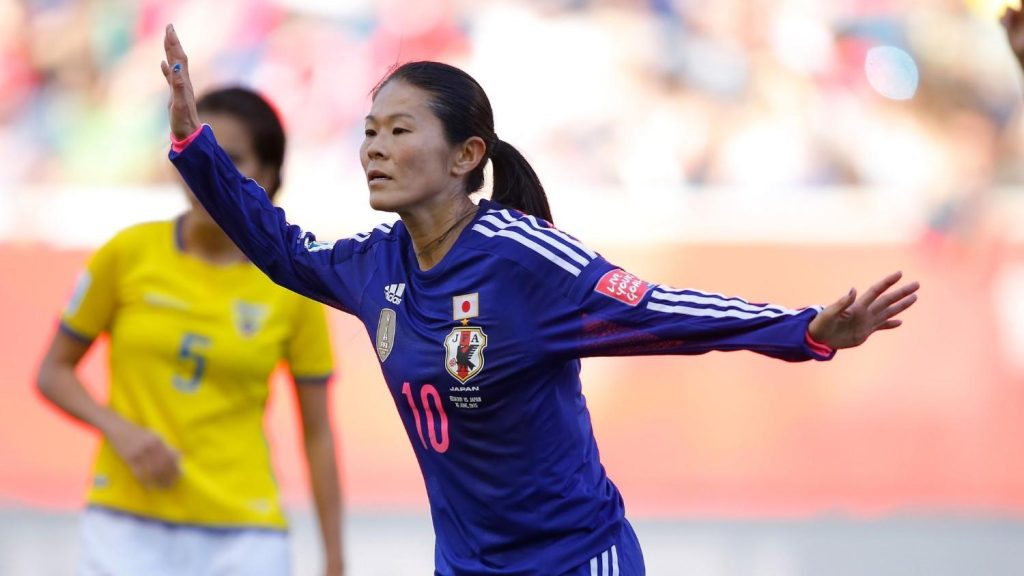
With 10+ goals in the AFC Women’s Asian Cup, Homare Sawa is one of the most decorated players in the tournament’s history. But her influence goes far beyond just this competition.
Sawa scored 6 goals in the 2003 edition, helping Japan finish third. She returned in 2014 after a brief international retirement to captain Japan to their first-ever Asian Cup title, scoring the opening goal in the semifinal against China.
Sawa’s Legacy Beyond the Asian Cup
- 2011 FIFA Women’s World Cup Winner — Golden Boot (5 goals) and Golden Ball (best player)
- 2011 FIFA Women’s World Player of the Year — first Asian to win the award, regardless of gender
- 205 caps and 83 goals for Japan — both all-time records
- Played in six FIFA Women’s World Cups (1995–2015), tied with Brazil’s Formiga for the all-time record
If there’s a Mount Rushmore of Asian women’s football, Sawa’s face is carved right at the centre.
7. Ri Kum-suk (North Korea) – The 2008 Knockout Specialist
Ri Kum-suk racked up 8+ goals, with 7 of those coming in the 2008 AFC Women’s Asian Cup in Vietnam.
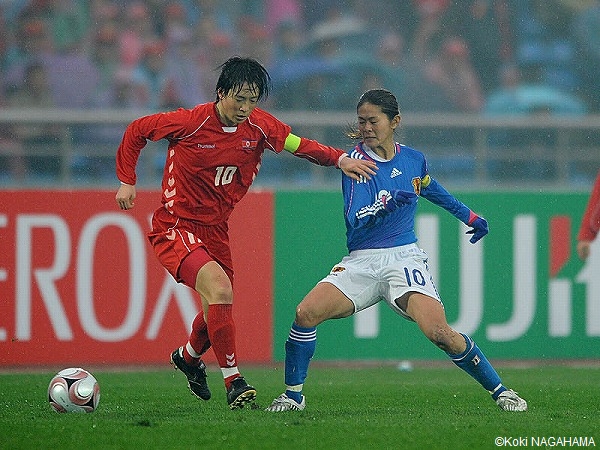
North Korea won that tournament, their third Asian Cup title, and Ri Kum-suk was instrumental.
North Korea’s women’s team during the 2001–2008 period was genuinely fearsome. They won back-to-back titles in 2001 and 2003, added a third in 2008, and conceded very few goals across those campaigns.
8. Lisa De Vanna (Australia) – Goals Across Four Tournaments
Lisa De Vanna scored 7 goals across four editions of the AFC Women’s Asian Cup. She was one of Australia’s most consistent performers at the continental level.

Unlike Kerr, who scored in bursts, De Vanna spread her goals more evenly. That kind of sustained tournament scoring over multiple cycles is its own achievement.
She was part of Australia’s 2010 Asian Cup-winning squad, the only time the Matildas have lifted the trophy. They beat North Korea 5–4 on penalties in Chengdu, China.
9. Yūki Nagasato (Japan) and Jung Jung-suk (South Korea) – The 2006 Class
Both Yūki Nagasato have scored 7 goals, with much of their scoring coming from the 2006 AFC Women’s Asian Cup in Australia.
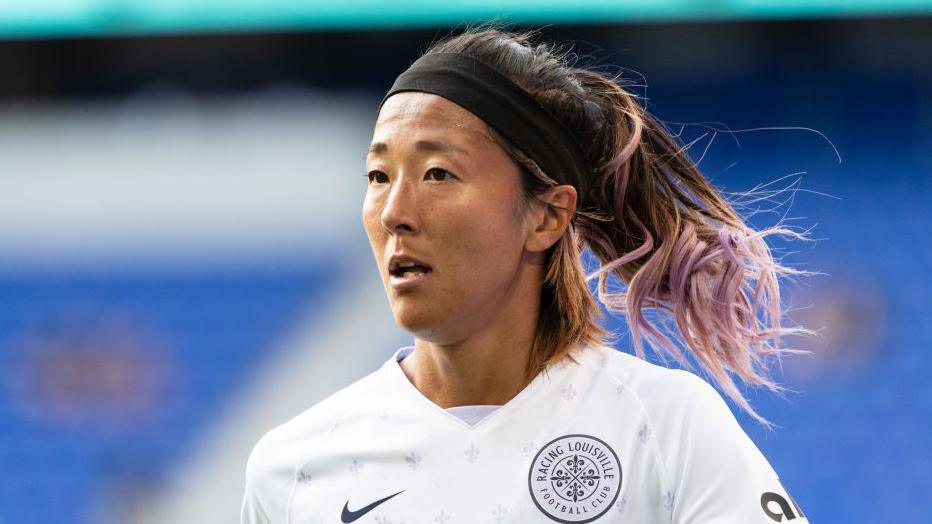
Nagasato (also known as Yūki Ōgimi) went on to have a stellar international career with Japan, winning the 2011 FIFA Women’s World Cup alongside Homare Sawa. She later played in the NWSL and Germany’s Frauen-Bundesliga.
10. Jung Jung-suk (South Korea) – The 2006 Class
ung Jung-suk sit on 7 goals, with much of their scoring coming from the 2006 AFC Women’s Asian Cup in Australia.
Jung Jung-suk was South Korea’s most potent goal threat during that period. South Korea has consistently been a top-four contender at the Asian Cup, even if silverware has been harder to come by. Jung Jung-suk went on to have a stellar international career with Japan
AFC Women’s Asian Cup: Title Winners at a Glance
Context matters when talking about goal scorers. The teams that dominated the tournament also produced most of the top scorers. Here’s how titles are distributed.
| Country | Titles | Years Won |
|---|---|---|
| China | 9 | 1986, 1989, 1991, 1993, 1995, 1997, 1999, 2006, 2022 |
| North Korea | 3 | 2001, 2003, 2008 |
| Chinese Taipei | 3 | 1977, 1979, 1981 |
| Japan | 2 | 2014, 2018 |
| Australia | 1 | 2010 |
| Thailand | 1 | 1983 |
| New Zealand | 1 | 1975 |
China’s 9 titles and 7 of the top 10 scorers being from China, Japan, or Australia tells you exactly where the power has always sat in this tournament.
What’s Happening at the 2026 AFC Women’s Asian Cup?
The 21st edition of the tournament is currently underway in Australia, with matches across Perth, Gold Coast, and Sydney from March 1–21, 2026.
As of March 16, 2026, the tournament is at the semifinal stage. The last four standing are Australia, China, Japan, and South Korea.
Key 2026 Tournament Stats So Far
- 82 goals in 22 matches (average 3.73 per match)
- Japan has been the most dominant team: 24 goals scored, 0 conceded through the quarterfinals
- Alanna Kennedy (Australia) leads the 2026 scoring charts with 5 goals
- The tournament also serves as the 2027 FIFA Women’s World Cup qualification for Asia
This is also the last time the Women’s Asian Cup will double as World Cup qualification. Starting from 2031, a standalone qualifier will replace it.
Why Do These Records Matter for Women’s Football in Asia?
The AFC Women’s Asian Cup has been held since 1975, making it the world’s oldest women’s international football tournament. Even older than the FIFA Women’s World Cup, which started in 1991.
Yet, record-keeping from the early decades was patchy at best. Many of the goal tallies on this list carry a “+” because complete match-level data simply doesn’t exist for some editions from the 1980s and 1990s.
This is a reminder that women’s football history deserves better archiving. Players like Jin Yan and Bai Jie scored goals that we can only approximate today.
On the brighter side, the tournament’s growth has been massive. The 2022 edition expanded to 12 teams. The 2026 edition is being hosted across three Australian cities with full broadcast coverage.
From 60-minute matches in 1975 to packed stadiums and World Cup qualification berths in 2026, the gap between then and now is staggering.
Which Countries Dominate the All-Time Scoring Charts?
A breakdown of the top 10 scorers by country paints a clear picture.
| Country | Players in Top 10 | Players |
|---|---|---|
| Japan | 3 | Mio Otani, Homare Sawa, Yūki Nagasato |
| China | 3 | Jin Yan, Bai Jie, Li Ying |
| Australia | 2 | Sam Kerr, Lisa De Vanna |
| North Korea | 1 | Ri Kum-suk |
| South Korea | 1 | Jung Jung-suk |
East Asian dominance is undeniable here. Every single player in the top 10 comes from East Asia or Australia (which joined the AFC in 2006). Not a single player from West, Central, or South Asia has cracked this list yet.
That said, teams like Uzbekistan and the Philippines have been making strides. The Philippines qualified for their first FIFA Women’s World Cup in 2023, and Uzbekistan advanced past the group stage for the first time in 2026.
Also Read:
- AFC Asian Cup Golden Boot Winners List (All-Time Scorers)
- Top Scorers of AFC Champions League Elite 2026 (Full List)
Mio Otani is the all-time top scorer in the AFC Women’s Asia Cup
The all-time top scorers in the AFC Women’s Asian Cup are a mix of legendary names and under-recognised talents. From Mio Otani’s record-smashing 2001 to Sam Kerr’s modern-day heroics, this list captures five decades of women’s football in Asia.
With the 2026 tournament still in progress, there’s every chance these numbers will shift before the final whistle in Sydney. Keep an eye on the action.